
Perry County VINELink Coverage
VINELink is the public entry to Kentucky VINE. Kentucky gathers reports from county jail booking systems, state prisons, mental-health facilities, and juvenile detention centers. That broad reach makes VINE useful for a KRRJ booking and for a KDOC prison record. KOOL differs because it covers state offenders and KDOC community supervision, not every short local jail stay.
A current-custody result supplies the jail or institution and contact information. Kentucky guidance says a person who is no longer in the reporting custody can appear as not in custody with a date released. Read the agency name closely. KRRJ can report one entry while KDOC reports another. A local entry marked released may reflect an exit before transfer into state custody.
| Population | VINE role | Second check |
|---|---|---|
| KRRJ detainee | Local custody and release status | KRRJ booking or release record |
| KDOC inmate | State custody changes and notices | KOOL or KDOC record |
| Community supervision | May reflect custody events | KOOL and Probation and Parole |
| Federal inmate | Not the correct locator | BOP Inmate Locator |
The Kentucky State Police registry is a separate system for the legally defined registered population. It is not a general release record. Absence there proves nothing about custody.
Search Perry County VINELink Records
Search one person with enough detail to avoid a false match. A partial name can help when spelling varies, while a jail or DOC identifier is stronger. Never select a record only because the name looks right. Compare the reporting agency, identifier, age or other available descriptors, and location.
- Open VINELink and choose Kentucky.
- Select “Find an Offender.”
- Enter a partial name or a jail or DOC offender ID.
- Compare identifiers and the reporting agency for all plausible matches.
- Open the matching record and read the custody status.
- If it says not in custody, record the released date and contributing agency.
- Look for a second local-jail or DOC record for the same person.
- Confirm with KRRJ, KOOL or KDOC, or the court record.
The Perry County release search overview places VINE in the larger evidence chain. A missing local result can mean different spelling, a reporting delay, or a case outside that data source. It is not proof that no booking occurred.
Perry County VINELink Release Fields
VINE is event based. Its fields answer which agency reported custody and what state that record currently shows. They do not explain the full legal reason for release. The KRRJ release record is stronger for the physical exit time and category. A signed court order is stronger for the legal authority.
| Field | What it means |
|---|---|
| Name or offender ID | Identity data used to match the person |
| Reporting agency | The jail or corrections source for that record |
| Custody status | Whether that source reports the person in custody |
| Facility or location | The reporting jail or institution and contact route |
| Date released | The release date reported for a not-in-custody entry |
| Notification option | Available channels for later status changes |
A date released should be attached to its agency. “Released by KRRJ” does not necessarily mean released by KDOC, BOP, ICE, or another jail. A transfer can close one custody record and open another. Check KOOL whenever a state transfer or state sentence is possible.
Register Perry County Release Alerts
Notification begins from the correct matching record. Kentucky offers phone, email, text, or in-app channels when available. Use a destination the registrant controls. A switchboard is a poor choice for PIN-driven phone calls because the automated service needs the registered person to acknowledge the alert.
- Open the correct KRRJ or KDOC record.
- Select “Notify Me of Status Changes.”
- Choose an available delivery channel.
- Enter the phone number, email address, or app details.
- For a telephone alert, create a memorable four-digit PIN.
- Complete the confirmation prompts.
- Enter the PIN when called to acknowledge the event and stop repeats.
Registration is also available by phone at 800-511-1670 around the clock. Kentucky materials describe registration as confidential. If both a local jail entry and a DOC entry truly belong to the same person, register on both. Each record can produce a different custody event.
The Kentucky Attorney General explains county-jail release calls and state-institution notice timing. Review the official Kentucky VINE guidance shown below before choosing the alert method.
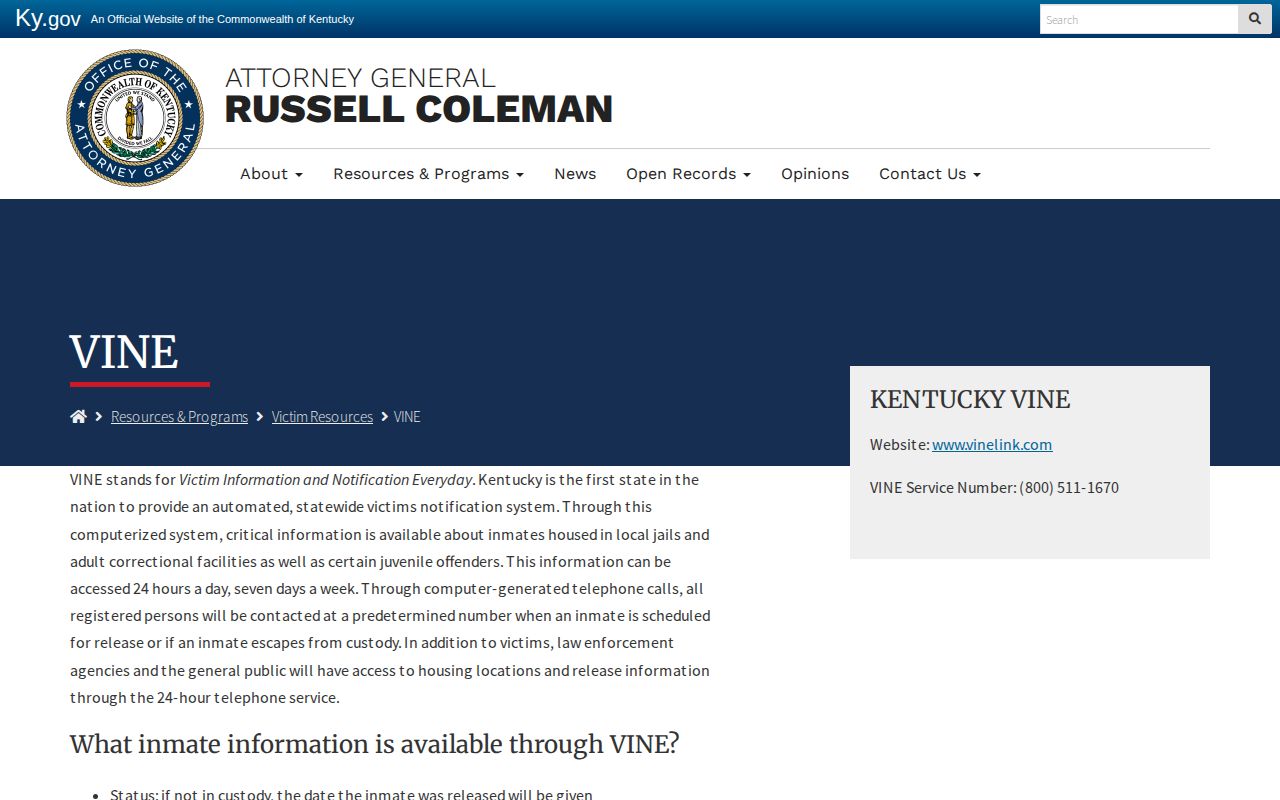
The guidance helps set expectations for calls and PIN acknowledgement, but direct agency confirmation remains essential after any alert.
Perry County VINE Alert Timing
County-jail release calls can recur every 30 minutes for 24 hours, or until the recipient acknowledges the event with the PIN. For a state institution, Kentucky attempts notice 72 hours before release where possible. Those figures describe alert behavior. They are not KRRJ online release-list windows and should never be presented as local roster retention.
Some releases cannot support advance notice. Parole decisions, court-ordered discharge, immediate credit changes, or escape may generate notice only when the event occurs. A late alert does not establish the time that jail staff completed processing. Ask KRRJ for the actual date, time, release type, and transfer destination when those details matter.
VINE is useful precisely because the live jail roster may drop a person after an exit. Still, a call, text, or email is a prompt to verify. It is not the underlying record. Note: Keep the record agency, alert time, and stated release date separate when building a custody timeline.
Perry County VINE Verification Steps
For a KRRJ result, call the official inmate-information or booking line and ask whether the booking ended in community release or transfer. Then request the release category and actual timestamp if releasable. Compare the court order when the legal reason is unclear. For a KDOC record, use KOOL and review status, location, supervision dates, and sentence fields.
Federal custody requires a different route. VINELink is not the BOP locator. A federal result should be checked in the Bureau of Prisons system, while immigration custody uses the ICE locator. A person can leave a local jail on a detainer and remain confined under another authority.
Three dates can all be valid: the court order date, the physical jail release time, and the VINE alert time. State records may add a supervision begin date. Arrange them in sequence instead of forcing them into one “release date.” That method resolves many apparent conflicts.
The Perry court record is useful when custody changed after bond, dismissal, sentencing, probation, or another judicial order. Obtain the signed order rather than relying only on docket shorthand. The order establishes legal authority, while KRRJ establishes when staff completed the physical exit. VINE may report the change after the jail sends it. Those records are complementary, and their timestamps need not match.
When a person may have entered KDOC custody, review KOOL’s status and location before treating a local not-in-custody result as community release. KOOL can show a supervision begin date and office after prison. If the status remains active at another institution, the KRRJ event was a transfer. If community supervision appears, confirm it through the state record and supervising office.
Build a short event line when two VINE entries appear. List the local admission, KRRJ exit, any KDOC admission, and the later state release or supervision start. Compare the identifiers on both entries. This explains why one record may say released while another still says in custody. It also prevents a local release date from being reported as the end of a state sentence. If the destination is unclear, request the KRRJ transfer or release field rather than guessing from the alert order.
Keep the VINELink record agency and offender identifier with each saved alert. Those two details let KRRJ or KDOC locate the event faster and reduce confusion between duplicate name matches.
Kentucky False VINE Release Alerts
KDOC disclosed that a vendor problem caused false state-custody release alerts on February 3, 2026. The agency took the affected service offline for a time, contacted registrants, and posted verified releases. The event is a concrete Kentucky reason to treat every automated release notice as an alert that still needs a source check.
The official KDOC VINE information page documents the service notice and Kentucky coverage. For a KRRJ notice, corroborate with the jail record. For a state notice, corroborate with KOOL or KDOC. A signed court or Board order may explain the authority, but the custody agency confirms physical processing.
The false-alert incident does not make VINE useless. It shows why two sources are safer than one. Preserve the message, note its time and reporting agency, and seek the underlying record before drawing a conclusion.
When a message conflicts with the live record, save both items and note the exact alert time. Ask the contributing agency whether the event was corrected, withdrawn, or replaced. A KDOC record can distinguish prison release from community supervision. KRRJ can distinguish community release from transfer. This short audit trail prevents a correction from being mistaken for a second custody event.
Perry County VINELink Screen
The public VINELink application starts with a state selection and Find an Offender path. The interface shown below is the proper national portal, avoiding similarly named or unofficial sources.
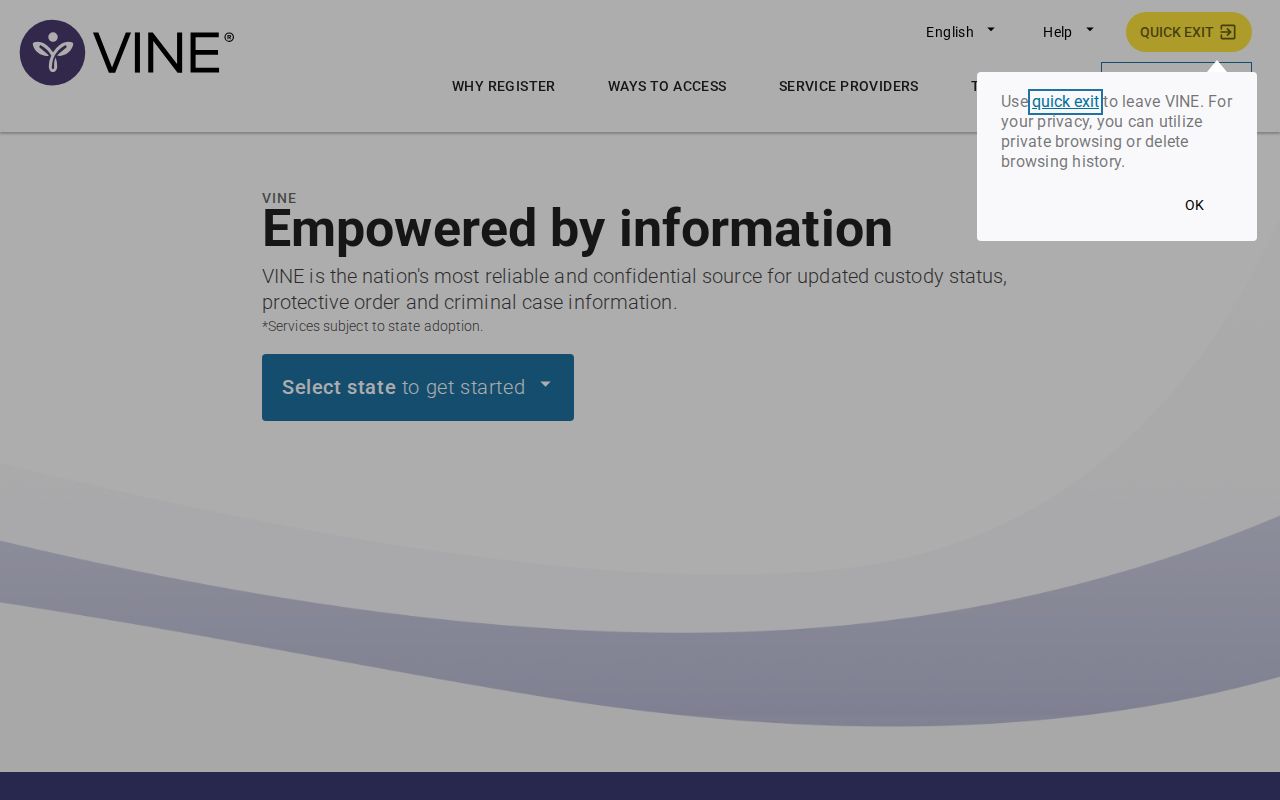
Select Kentucky before searching, then verify KRRJ or KDOC as the contributor. That agency label controls what a released result actually proves.